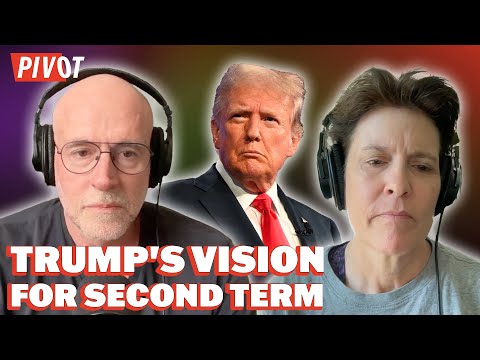
The Dangers of Donald Trump's Dictator Praise | Pivot
Ask about Pivot with Kara Swisher and Scott Galloway
Episode Description
Is Donald Trump's praise of dictators bluster, or part of a larger strategy? NYU professor and author of "Strongmen: Mussolini to the Present," Ruth Ben-Ghiat, talks to Kara Swisher and Scott Galloway about how Donald Trump's behavior is reminiscent of other autocratic leaders.
Read the full transcriptHide the full transcript
- Ruth uh Ben Ben Gat is a professor of history at NYU and author of strong men musolini to the present she also writes
- the substack Lucid oh what a good name which focuses on abuses of power and threats democracy Ruth welcome thank you
- I'm so glad to be here so we want to talk dictators uh I want to start with something you posted on X last week
- after Donald Trump shared violent imagery of Joe Biden on true social you wrote wake up people this is an
- emergency uh a lot of people have concerns about that imagery but what it specifically that made you sound the
- alarm here you've been doing it for a while so I'm not so sure that's the newest thing in the world for you but
- but talk about why why that bothered you in particular of the many things that could bother you about Donald Trump yeah
- so it's about you know because because I feel like uh Donald Trump has been um waging and his GOP enablers have been
- waging uh a whole campaign to delegitimize all of our Democratic institutions and in particular uh you
- know attacking Joe Biden this was an image which uh showed Joe Biden it was a you know a sticker on the back of a
- pickup uh as though he were a hostage uh kidnapped and if you study coups a third
- of my books strong men is about coups and authoritarian takeovers what is this showing it's
- showing an outcome of a political situation where Biden is has met a bad end where he's somehow been overthrown
- and ended up tied up mhm and this is being uh you know this is being depicted as something positive and so it's
- continuing the coup and it's just it's it's extremely dangerous uh for obvious reasons and I feel like this is um
- normalizing this is allowing people which is the point right I mean you you called it you said Trump's repeated uh
- elevation of dictators as models of leadership should be understood at part of a re-education strategy and one thing
- he does is this is not new he that was CNN if you remember him punching CNN y that this was a years ago he he did one
- that I wrote a column about when he was you not just um you know standby and stand whatever the heck he said he says
- it a lot it's but it's not a new Fresh thing but you're calling it a re-education strategy that's been
- ongoing right that it hasn't stopped the coup and he continues to do that explain
- why because because he says he's joking he says he's kidding he's this is just him that this is his brand of humor such
- that it's not funny but still um talk about the re-education part of it yeah it's it's interesting what he's been
- doing uh and this is since the fascists uh melini and Hitler you've got to re-educate people uh to see violence in
- a positive way and even make it into something patriotic and even morally righteous and Trump has been using his
- rallies since 2015 and uh this was part of my report for the January 6 committee he's been
- just over and over saying like oh in the good old days we used to be able to punch you know protesters so there's
- that vector and then uh he's been also elevating dictators like doesn't matter you know North Korea China whatever they
- are communist fascist uh as as positive models of leadership Orban he had he recently met with uh Victor Orban from
- Hungary go ahead yeah and so Orban what does he say I take seriously what says and he says that you know orban's so
- great he's so strong because he says this is how it's going to be and everybody just accepts it so he's
- telling us what his what he's telling Americans his followers that this is a positive model so if you take the
- violence as a way of moving history forward which was January 6 and you take the positive um refor the positive
- praise for these murderous dictators you get a re-education strategy because he said saturated the media environment for
- now many years over and over and over again it's nice to meet you Professor I don't think we've met before um so we
- spent a lot of time talking about what a danger Trump is and how wrong and really
- um anti-American a lot of his activities much less his rhetoric are but he was he
- was elected uh by the US and he continues to pull really well despite all of these
- things that are horrific to everyone on this podcast what is it about the atmospherics in the US um um that has
- led the populist to support this individual who we all agree uh does not acquit himself as we would
- want someone who wants to be the president what's happened in America what's changed here that's a great
- question and um there are patterns to these things and uh in the research for my book when when there's been a
- perception that um there's been too much Social Pro progress and and certain people are losing out uh it could be
- conservative Elites uh who are worried about losing their privileges um it could be people thinking there's too
- much gender emancipation too much uh racial emancipation you get a kind of counterrevolution that's a that's a big
- word or you get a backlash and and that's when somebody like a Donald Trump is appealing but but
- a Donald Trump also um models himself for that environment and the thing about these strong men is that they're highly
- sensitive to they read the marketplace and they understand what is uh want what is wanted and they model themselves they
- will be whatever they need to be to get to power because they have no morals they're just about getting control so so
- Donald Trump comes up and he was the perfect person as the anti- Obama um and he he was the the male brute so he
- addressed the people who felt that you know women had too much power uh same-sex marriages were taking over all
- of the racial stuff and so that's that's what he did and he and he also told these people that he loved them that
- they were the Forgotten and so there's a sense that he's not just going to represent them he's going to protect
- them and take care of them Daddy a big daddy he's daddy he's big daddy and he's remained Big Daddy and once they bond to
- him and they feel feel protected U but they're also protective of him because he's also the victim and musolini was
- the victim erdogan's the victim they all do this and it's highly effective this manipulation of emotions Scott you write
- about you know masculinity and and emotions and and Trump is the latest example of somebody who's extremely
- skilled at using this can I can I ask a followup Tera go ahead first off Professor I I just think what I think
- that's such an important point because been thinking a lot about row recently and I don't think people zero
- in on some of the things you're talking about to really understand and I would just want to double click on it my sent
- as you talk about them wanting to return to an Era where they were more comfortable and I think it's more
- specific than that um just as young men have fallen further faster than any group in America the ascent globally of
- women over the last 30 years is unprecedented they've doubled their elected positions in parliaments there
- are now more women globally enrolled in tertiary Ed education in men and I think
- the extreme of any religion is really uncomfortable and wants these up women to sit down and I think it's I think
- it's I think that's what row is I don't think it's about birth isn't this specifically about telling um very
- conservative sex who sex of of of of of religious extremists who have disproportionate power and unfortunately
- young men who feel shunned by women then I'm going to take power back from women
- oh totally and who better than a repeated you know abuser uh somebody who boasts about you know uh putting women
- in their place and and this was part of his marketing strategy from the very beginning and that's why when the um Hol
- the Access Hollywood stuff came out I knew that it would actually help him because you know this who these are the
- people I study it's been it was horrible to write the book and be in their heads
- you know melini was a serial rapist um and many others Qaddafi as well so this is part of their their Glamour and until
- we uh wean ourselves from this kind of toxic brute you know idea that this Brute Force this this this ideal of
- masculinity is glamorous and desirable we're going to be susceptible to these Donald Trumps so can you ask the
- similarities can I pick up on that between Trump and some of these classic dictators I did not know that about M
- musolini are there differences also yeah the outcomes are different so you know we're not going to whatever happens is
- not going to be a a hitlerian one party state or or a North Korean one party state but um the similarities are that
- they these people are highly sophisticated at communication and whatever the era they're in they use the
- latest tools of communication to forge a direct and unmediated bond with their followers so musolini uh you know was he
- was gesticulating and he started in the age of Silent Cinema he used news reels now Hitler of course
- he had the radio um and he ranted and the Nazis invested in like state-of-the-art uh audio technology uh
- so that when he had rallies his voice would reverberate in ways that made him feel seem more Godly because that's part
- of the personality cult so they all do personality Cults which the it's so interesting the rules have not changed
- for hundred years you have to be a man of the people so you're relatable and certainly Trump is but you have to be
- the man of above all other men so they all use this and so Modi used um Holograms uh when he ran initially for
- office so he could be everywhere and nowhere like a god uh berus scone who owned TV networks use satellite TV to be
- everywhere and Trump used Twitter so that's one thing they do they have these bonds with uh that people feel they're
- speaking directly and only to them which is which hasn't changed for a hundred years if you're advising the white do
- how would you match this because Biden's certainly not that person I yeah I think
- um in general uh the we can learn from autocrats uh uh to make more use of emotion in politics there's one of the
- things that autocrats do really well is create these tribes and these communities and they make people feel
- cared for it now it's bogus of course they're just really trying to manipulate them Trump doesn't care you know at the
- beginning of the pandemic I didn't an interview and I told I said that uh Trump doesn't care if you live or die
- and people got upset but that's just how it is but they seem to care about people
- so so Democrats in general around the world can make more use of emotion of joy of Hope of love and and Biden does
- this in his own quiet way but um it it it it'd be ideal if if it's somebody who is a more charismatic energetic vehicle
- for that kind of is there someone like that is there someone like that um I'm I'm not sure I mean I'm a
- big fan of Pete buddh as a communicator um and he's he's been he's got a restrained personality but he's able to
- talk he goes on Fox and he's liked on Fox he's a very very he's a great asset as a
- communicator um and he has everything I think um as a communicator and he could develop in this direction uh if given
- the space what about worries you the most about a trump second term um I what worries me the most about Trump's second
- term is that he has been very clear about his intent to um have an American version of fascism um now that's again
- that's not going to be a one- party state but he wants to uh turn the US you know AR the military if he could but
- certainly um law enforcement to repress uh large numbers of Americans to deport you know millions and he would uh stop
- at nothing to try and gain total control uh of the United States and that's what
- authoritarianism is at its very essence it's the it's the executive trying to um
- you know overwhelm and the other branches of government so that they can be safe and be uh never prosecuted again
- can he actually do it we're such a big and diverse country with so many like you can't imagine California going along
- there's elements in every state like this but how do you manage to do that I mean Germany was a very particular
- smaller country so it was Italy so is Turkey in a way you know although it's much more diverse turkeyy is more
- diverse with Eran um how do you and certainly Modi has has has done that but has limits has had limits in terms of
- what he can do so how do you look at that is that is is that a possibility I we've all seen the science fiction about
- it we've all seen those apocalyptic movies where that happens um yeah I mean to Hitler you know hit musolini is
- actually a better example um or somebody like an orbon because to versus Hitler because today things often H happen
- gradually um you but Trump is you know and project 2025 is about you know having an accelerated transformation of
- government using executive orders perhaps the Insurrection act and you know we know
- there are many things that he can do the main thing that definitely would happened because it happened during the
- first Trump Administration is so that Trump is not interested in governance he's interested in using uh public
- office for private benefit and you know in his first Administration he spent one
- out of every three days not governing at the White House but visiting Trump branded
- properties and so this kind of enrichment uh of you for you and your family and cronies that definitely would
- go on he's already said you know he's boasting that he accepted uh money during his first presidency from the
- Chinese for quote services and I'm still trying to get somebody to ask him what those Services were so the White House
- would be for sale uh our intelligence would be for sale perhaps it already has been you know keeping documents in his
- bathroom all of this uh left lack of um accountability and eraser of public versus private that's the strongman
- thing they don't they don't accept any eraser any divide between public and private it's all theirs and it's all
- Theirs to sell and profit from um Professor my sense is the the media has a difficult time trying to figure out
- the approach to covering Trump do you do you have any thoughts around where the media has has uh
- succeeded or not succeeded and in the role the media plays to trying to figure out how to cover this guy great
- question yeah yeah it's a little like Frederick burchall in the New York Times Reporter
- who sort of normalized Hitler for a long time oh yeah and and mus musini actually
- had a column A syndicated column because uh the anti-communist uh Baron Hurst was
- his backer that reached uh a thousand newspapers for eight years in the United States so talk about normalizing I think
- you know we know the the the Press has been it was working with an outdated Playbook uh A playbook that worked uh in
- in terms of two um if you had two candidates and two parties that were uh that still bought into democracy the
- problem is it's they've been slow to understand how to cover our situation where we're a bipartisan Republic but
- one of our parties no longer is in democracy I see the GOP as an autocratic party and if it were a sovereign entity
- its foreign policy would be pro- autocratic Pro Putin Pro orbon that's a reality and they've struggled so that's
- where they they they still do the both sides ISM um but it's a little more subtle because for example Meet the
- Press um which which has a bipartisan uh viewership um um Kristen Welker has done
- very well actually bringing Republican guests on and probing them and the audience there are Republicans who don't
- want to see perhaps a republican um aggressively bashed but will listen to a careful probing of their
- hypocrisies of their inconsistencies so so there it's just uh you can you can think that this more
- gentle approach is perhaps not appropriate for our emergency but it depends what your aim is MH so good or
- what what should they be doing con proving I think that uh the headline writers are they a lot of PE
- you know there's a lot of headlines that are unhelpful for example even in the Washington Post and certainly in the New
- York Times uh also the placement of important stories about Trump's corruption uh often the New York Times
- will put it on page you know 8 13 I think that if we want to prioritize our de saving our democracy we have to have
- a different kind of placement of uh these big stories um also to show the American public that people are being
- held accountable when January six uh you know insurgents are sentenced uh when the doj is doing things to restore faith
- in institutions because bashing the Press is a popular habit but it's a symptom of also of this um success of
- the right of uh making people lose faith in all institutions right absolutely um
- they uh I think one of the issues is Trump and his cronies especially T Bannon flood the Zone with crazy all the
- time and so you get exhausted including January 6 and so you're like G I'm tired
- of listening to it kind of thing anyway it's a really important book there's a lot of really important books out these
- days in this area Ruth Ben Gad uh her subst is called lucid and her book is strong men musolini to the present light
- Little Light reading for you Ruth thank you so much thank you I enjoyed the conversation
Brief Summary
Ruth Ben-Ghiat discusses Trump's authoritarian tactics, media coverage, and the implications for American democracy in this episode.
Key points
- Ruth Ben-Ghiat on Trump's Dangerous Rhetoric. Ruth discusses how Trump's violent imagery and rhetoric threaten democracy.
- The Re-Education Strategy of Trump. Ruth explains how Trump's elevation of dictators serves as a re-education strategy.
Episode highlights
- Ruth Ben-Ghiat on Trump's Dangerous RhetoricRuth discusses how Trump's violent imagery and rhetoric threaten democracy.“Wake up people, this is an emergency!”0:24Apr 10, 2024
- The Re-Education Strategy of TrumpRuth explains how Trump's elevation of dictators serves as a re-education strategy.“Trump's repeated elevation of dictators should be understood as part of a re-education strategy.”1:50Apr 10, 2024
Tension
65/ 100Some tension